

5 Ways the World Will Tell You It's Time to Call a Professional Writer

Happy New Year from The Brandstalk!

Have you resolved to give your business a kick this year?

One way to do that is to hire a professional writer. But how do you know if you need one? I asked Bridget Lyons, who is the Interpretive Sorceress behind Spiralglyph Media, to help me give you guys an idea on when it might be time to pass the pen. Take it away, Lyons…

5. You’ve noticed that your sentences often go on for three, four, or even (gasp!) five lines.

20170118_102205.jpg

You might ask your employees to multi-task, but you shouldn’t ask your sentences to do the same. In the ideal world, each of your sentences should be carrying the weight of one – and only one – concept.  But your brain is so familiar with your thoughts, your business, and your stories that it thinks a convoluted multi-clausal sentence dotted with and’s, but’s, and semi-colons is presenting only one idea when in fact it’s packed to the gills with information (see what I mean?  That sentence was too long!)  It often takes an unbiased third party to hunt these Tetris-like rascals down and break them up.  That third party is a professional writer.

4. You’re repeating the same words, over and over and over…

Let’s face it, we’ve all got our own vocabulary.  We use certain words so often that they identify us.  (Ask your friends – they’ll tell you what your favorites are!)  In person, these words give us personality.  In writing, they make us look boring, milk-toasty, and even – god forbid – dumb. Great marketing text is spicy, sparkly, scintillating.  What creates flavorful copy?  Juicy words.  These gems are the currency of the professional writer.

3. For your “elevator speech” to work, you’d have to be in a 200-story building.

omni_small.jpg

Seriously, you know you’ve got to be able to articulate your unique offering in under a minute.  These oft-touted “elevator speeches” do not sprout up spontaneously in the backyard of your consciousness.  They are earned through a long process of thinking, brainstorming, and wordsmithing.  A professional marketing writer knows the questions that get this process going as well as what to do with the answers you provide.  Imagine being handed a perfect three-sentence encapsulation of your service or product that reflects your voice and style.  You can commit it to memory, shout it from the rooftops, and plaster it all over your marketing materials. With some professional assistance, this could be your reality.

2. You think you have a story to tell, but you’re not sure where to start.

start.jpg

“It’s all about your story,” everyone says.  And for a good reason – your company’s story is a big part of what draws your customers to you.  It’s an even bigger part of what keeps them around.  Compelling stories are key, and so is the telling of them.  How do you get your tale on paper (or on screen, as is more likely the case these days) in clear and engaging language?  It’s not an easy task – that is why professional writers exist.  This is what we DO.  Like, all the time.  We listen.  We ask questions.  We write.  And then we add and delete and spin and spit and polish until we are blue in the face and your copy gives us goose bumps.

1. You don’t know the rules of comma usage, and quite frankly my dear, you don’t give a damn.

punctuation.jpg

Fair enough.  We writers know them all, and we think they’re fascinating, but we’re verbal dorks.  If you didn’t think grammar was interesting back in high school, you’re probably not going to now.  Sure, you could hit the books and learn all the rules.  And you could also teach yourself website design, bookkeeping, stock trading, head-shrinking, and all the other services you hire people to do for you.  Or you could contact a writing professional and use your free time to do something YOU find fascinating.

About Bridget

Bridget Lyons likes to call herself an Interpretive Sorceress, which really just means that she’s a word geek and a design dork.  Through her company, Spiralglyph Media, she helps businesses and individuals craft timeless visual and verbal expressions for web and print.  She also edits fiction and non-fiction texts for budding authors and is currently working on her own second novel.  Bridget and Erica play well together in the creative sandbox and enjoy collaborating on a variety of branding and marketing projects.


Thanks Bridget! We love comments and tweets about when you realized it was time to bring in the big guns. Or maybe it just happened while you were reading?

The Marketing Spritz

When I was teaching my marketing class last fall, I talked about the “spraying and praying” marketing approach. The short version of this is doing any and/or all communications activities without a clear strategy and goals. It probably goes without saying that I don’t recommend this approach.

But sometimes “spritzing” is ok. I didn’t realize how my students fixated on this conversation. I saw a couple of them a few weeks later.

“Hey! I ordered some stickers. It’s a spritz!”

“I want to place an ad in the paper for the holidays. Is it an ok spritz?”

spray bottle.jpeg

So what the heck is it?

Spritzing is often a one-off activity, or a tester to see if something works. It’s not necessarily part of your regular strategy, or it could be something you do before you are finished with your strategy. Here’s an example:

After I started my business, I was approached by a non-profit to sponsor the local ice rink with a banner. The pixels were barely dry on my LLC paperwork, my website wasn’t launched, but my logo and branding was shiny and new. I was excited to get out there and it was an affordable investment. Did I have any demographic info? No. Was this advertisement in line with my brand? Not sure.

One banner please and thank you.

So why did I do it?

I wanted to do something to promote my business and feel like I was moving forward. It was a low-risk way to do so. I also wanted to determine if sponsorship banners would bring in business. I knew I would be approached in the future by the gajillion non-profits around here and it would be great to have a baseline.

Most importantly, the ice rink is an important part of this community and I wanted The Brandstalk to support it. I’m a recreational ice skater, my husband is a life-long hockey player and it’s always nice to have variety in winter activities in Teton Valley. As I put together the pieces of The Brandstalk, one of my intentions was to share my success with Teton Valley non-profits that supported causes I was passionate about.

No, I won’t yell at you if you Spritz. Or buy a couple radio ads to drum up interest. Or order promotional stress balls with your logo on it. Just ask a few questions first:

  • Can I afford it if it doesn’t work? This is not just about money. Think about things like time, production and visual impact.

  • How will I track the response?

  • What other benefits might I receive other than straight business? Think about impressions (eyeballs), chatter, goodwill and experimental data.

 And of course some questions for after:

  • Did it distract from my brand?

  • Or did it auto-magically contribute to my brand promise?

  • What can I improve for next time?

  • What did I learn so I can make better calls on the next Spritz?

Video Block
Double-click here to add a video by URL or embed code. Learn more

4 Things I Learned from Teaching a Marketing Class

20161004_210126.jpg

I recently taught a marketing class through Eastern Idaho Technical College— “Marketing Jump Start.” The concept was to present Marketing 101-type information and help people move on with the next communications phase or project within their business.

mktgjumpstart.jpg

Let’s back up. While I don’t consider myself shy and I don’t get anxious about speaking in public, I’m not a natural teacher. I always struggled when I had to train co-workers. I have always needed extensive prep when getting ready for sales meetings, trade shows, client meetings and work presentations to make sure I was clear, didn’t over-talk or sound scripted. I worked hard to anticipate questions or objections and prepare responses.

Agreeing to teach Marketing Jump Start was a bit of a stretch for me, but I was eager to do it. I knew I would learn a lot from the preparation of the class, and even more from teaching it. Here are a few top experiences I had during my time as Professor E.

  • Distill down info into bite size pieces.

This is just like marketing communications. But I didn’t know that before I started. I thought teaching would be dramatically different than talking about a product or service to a customer, but at a basic level, it’s really not. I took the concept I was teaching and peeled back the layers until I got to the reason why it’s worth talking about. This is the same with your product and brand- figure out what’s really important, why people should care about it and build from there.

  • Use “strategic teaching techniques.”

The Coordinator came up to me after class and said:

“I was only in here for 3 minutes and I saw you using 3 key teaching techniques.”

Me: “Ummm….what?”

It was a happy accident. I didn’t even know what a “teaching technique” was. I should have done some research on “teaching techniques” beforehand, but I was so focused on having good content and being prepared, I figured the delivery would fall into place. I suppose concentrating on content and preparation is a decent teaching technique in a way.

eitc.jpg
  • Public speaking is an art and a skill.

Thanks to a high school speech class where I yakked about Neil Diamond and provided a “How-to” speech on ear piercing, a former career as a tour guide, years of sales meetings, attending trade shows, showing up at networking events and going on sales calls for my own new business, I’m no stranger to talking to strangers.

That doesn’t mean I’m good at it. If you think you have enough experience, you probably need way more. And the only way to get more is to do more. I’m going to continue to work on both the art part and the skill part.

  • It was just plain FUN.

It was like having 4 informational interviews at once. I got to learn about other people’s businesses, what they are afraid of, what annoys them. They were open about what they could and couldn’t get done. They asked questions, offered answers, even for my own business. At 8:57 when there was 3 minutes left of class, I was bummed that it had to end.

I won’t hesitate to teach the spring session if I am asked and I look forward to adding to my list of things I learned. When’s the last time you did something outside your comfort zone? What was your most colorful lesson?

footer_l.jpg

You Had Me at "Brand."

argue.jpeg

This morning I listened to a story on NPR “Feelings Toward A Partner Affect Brand Buying Decisions, Study Says”.

Huh?

We all know there are lots of tangible and intangible things that affect buyer behavior, so this shouldn’t really be a surprise. But thumbs up to the curious researchers- Gavan Fitzsimmons (Duke University) and Danielle Brick (University of New Hampshire)– and NPR headline writers for making me turn my head.

The research asserts that when you are enjoying relationship health and positivity, you stick with your “normal” brands or even those preferred by your partner. In adverse times, you buy brands that your partner dislikes and even those that you may not like in this “act of defiance.” Listen to the story here:

https://www.npr.org/player/embed/502274818/502274819

Here’s an example: Last year, I was annoyed with my husband for leaving hockey gear askew around the house. I asked him to clean it up a few times, or at least get it into an under-control pile, but life got in the way (or probably a hockey game) and it wasn’t happening. On my next trip to the store, I found my huffy, pouting self in front of the hard cider section. I don’t love hard cider, but might enjoy one every year. Hockey Husband really makes a crazy, contorted face when he hears “hard cider.” Yep. I did it. I rebelled.

Host Steve Inskeep asks if marketers can use this to sell more product. To do that, there’s a lot of projection, inference and assumption that the marketer has to do- likely more than even big brands are comfortable with. And let’s talk about right time- right place. If you think getting a video to go viral took some luck, try to guess when couples are fighting.

products.jpeg

Let’s just get crazy and say Potato Chip Brand A decided to capitalize on this concept. How does it even fit into their brand story? Will it alienate a major audience? Is it a one-off promotion? How can they build the message without injuring all the brand work they’ve done so far? To me, it doesn’t sound like a solid campaign concept, but it’s worth exploring. Here’s a link to the full study: http://www.journals.uchicago.edu/doi/abs/10.1086/688755

I think people are “buying defiantly” because it makes them think they are having their own experience, not one shared with the person that ticked them off. They are also simply being normal passive aggressive humans that are trying to soothe themselves with retail therapy.

What other ways might your personal relationships affect what you buy or don’t buy? What about your customers and what’s happening behind their scenes? What did you think about the story? Let me know in the comments below or on Twitter.

footer_l.jpg

New Resource for Local Business Pros (OR WANNA-BES!)

Artboard 1.png

Are you stuck on a business project? Have an idea, but don’t know where to start? Looking for feedback? Need accountability for work milestones?

Join The Biz Posse! We meet on the 3rd Tuesday of every month at the Driggs Library (79 N. Main St.). This group is open to business owners, entrepreneurs and everyone in between- even students looking to explore the world of business ownership and management.

This is an open, casual format with a fun, creative, motivating group. The next session is on November 15- see you there!

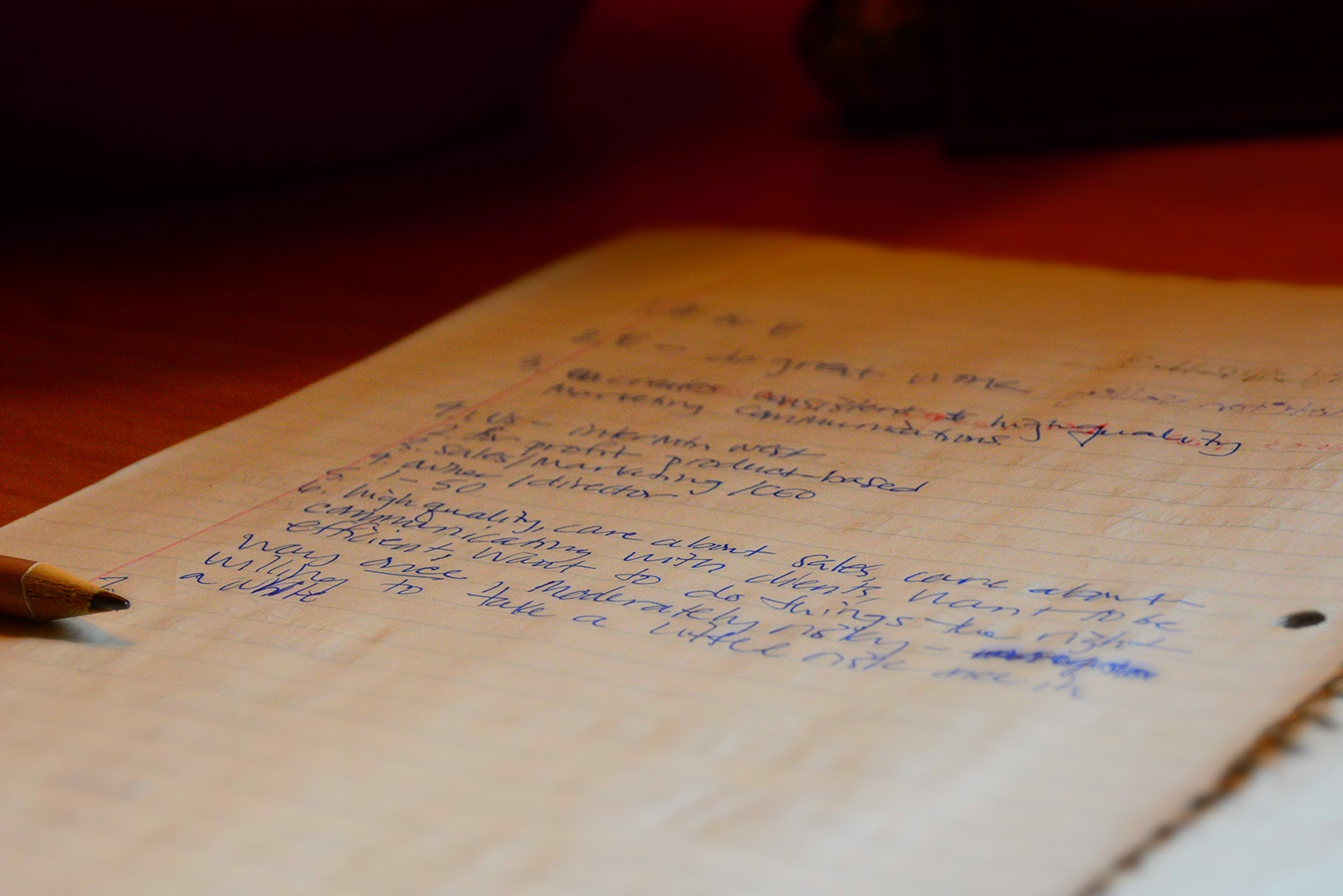
Handwriting. The Struggle is Real.

EKR_1161.JPG

When I was in elementary school, I learned how to write using the D’Nealian method.There were cool workbooks with the line-dash-line paper and lots of things to trace. Cursive was fun until I realized my teachers were going to require all assignments be written in cursive for the next 6 years.

dnealian.jpg

Then high school came. Freedom to print. OR WRITE IN ALL CAPS. oR mIx it Up, EveN iF iT Wuz on mY teal NoTeBooK. Maybe I could even use the typewriter for a couple papers (gasp!). Until I walked into Russian class. We would learn the Cyrillic alphabet and write in Cyrillic cursive. Curses!

In college, when I finally graduated from my hand-me-down Smith Corona word processing typewriter (thanks Big Sis), it was computer time. I barely picked up a pen again for years and I was relieved. Despite the lifetime-so-far of practice, my handwriting was fair, but often sloppy. Typing was faster and it was consistent.

smith-corona-5f-sd860-word-processing-typewriter-2.35.jpg

Fast forward to 2013 when I took a position in the retail industry. We started a chalkboard signage program where I had to develop the standards. This was a blast, but the person in charge’s handwriting and general pen-holding skills (mine) had morphed into a mush of letters borrowed from 2 different alphabets. In a word: mess.

So I bought a sketch book and a pencil sharpener and practiced writing “Strawberries” “New Flavor!” “$7.99 / lb”. I saw my handwriting transform from mess to passable.  I enjoyed sketching out chalk boards beforehand and refining as they were drawn.  I found myself busting out the sketchbook for non-work drawings, quick diagrams or doodles. My regular meeting notes and quick stickies to my co-workers were legible to more than just me. My handwriting steadily improved and it triggered a pocket of my brain that a keyboard could not. Decent handwriting was an analog skill.

EKR_1164.JPG

2014 article in the New York Times suggests handwriting is key to educational development and mental stimulation. For adults, handwriting may help information processing and focus.

A few months after starting The Brandstalk, I looked down at my day’s notes. Donald N. Thurber- the  creator of D’Nealian- was probably poking his eyes out with No. 2 pencils. I’d lost that attention to my handwriting that was so crucial to communicating the right product and price to the customer, the response rate my co-worker had asked for or completing an application for a special event permit.

More importantly, I’d forgotten how great it felt to activate that circuit that psychologist Dehaene mentions. So I am back at it with the sketchbook, the adult coloring book and writing my work notes as if my team of creative cronies needs them for the next project.

Do you have a handwriting story? Please share it in the comments or let me know on Twitter.

footer_l.jpg